Reviewing your HOA’s financial statements isn’t just a best practice—it’s essential for protecting your community’s long-term stability. Whether you’re a seasoned board member or new to HOA leadership, knowing what to look for in your financial reports can help you spot trends, catch inconsistencies, and confidently make informed decisions.
1. Comparison Variance Report
The month-to-date and year-to-date budget comparison variance report is a great place to start your financial report review. This report is designed to provide board members with explanations of variances beyond the information supplied by dollar figures in a standard income and expense report. Your Community Manager can explain valuable operating and reserve activity details that cannot be captured in standard accounting reports. Also, it will assist you with questions you may have about the financial performance of your community. It may also answer many questions before board meetings, so meeting time can be allocated as efficiently as possible.
2. Balance Sheet
A review of the balance sheet will provide the Board with a snapshot of the Association’s assets, liabilities, and equity as of the end of each month. Operating and reserve cash balances are listed separately so the Board can make informed cash flow decisions. AAM’s accounting staff members reconcile each operating and reserve bank account every month. The full HOA financial package provides Bank reconciliations and statements to ensure financial transparency. As part of the reconciliation process, our accountants ensure that total account balances do not exceed FDIC limits at each financial institution. They also assist in setting up new money markets and certificate of deposit accounts.
3. General Ledger
The General Ledger is the source of all accounting data used to build the monthly HOA financial reports. Reviewing this activity provides detailed debit and credit information for each transaction processed during the monthly reporting period. Digesting this information may be a challenge, but once you are familiar with the report format, you can find many of the answers you might be searching for. It provides transaction dates, code descriptions, memos, debits, credits, and dollar figures.
4. Transparency
At least one designated Board member (generally the Board Treasurer) receives an additional monthly PDF file by email containing images of all paid invoices. This information is available to provide financial peace of mind and full transparency.
These are just a few quick tips for reviewing the monthly financial reports. Please feel free to contact your Community Manager as a starting point for any questions related to the financials. Additionally, we have an experienced and dedicated accounting support team ready to assist your Community Manager and Board of Directors at all times.
HOA Board of Directors Duties – Who are they, and what do they do? Generally, an HOA Board of Directors comprises community volunteers elected by fellow residents to serve on the Board and make decisions on the residents’ behalf regarding the HOA.
Below is a brief overview of the HOA Board of Directors’ duties and responsibilities.
What is the structure of your HOA Board of Directors?
In general, the Board of Directors consists of five (5) officers:
President:
The HOA President’s role is performed by someone knowledgeable of the community’s governing documents, oversees the community association’s operations by ensuring orders and resolutions are carried out, signs contracts, and co-signs checks. He or she leads all meetings, acting as the foreman.
Responsibilities:
Managing the overall operations and initiatives of the association
Making key decisions that impact the community
Leading and facilitating board meetings
Vice President:
The Vice President performs other duties as required and will replace the President when necessary. Equally, the Vice President should have in-depth knowledge of the community bylaws and regulations.
Responsibilities:
Assumes the president’s responsibilities when the president is unavailable
Secretary:
The Secretary keeps meeting minutes, records votes, and maintains compliance with essential association documents. The secretary is also responsible for informing board members and residents about upcoming meetings and documenting the meeting minutes.
Responsibilities:
Manages the association’s official records and documentation
Sends meeting notices and takes minutes during board meetings
Treasurer:
The Treasurer keeps track of the association’s finances and reports on monthly financials at board meetings.
Responsibilities:
Supervising the financial operations of the association
Creating and planning the annual budget
Maintaining accurate and up-to-date financial documentation
Handling tax-related obligations for the association
The HOA Board members must ensure that the community is maintained by enforcing the community’s CC&Rs and Bylaws. Most importantly, board members should be fair and honest and keep the homeowners’ and the association’s best interests in mind when making decisions.
Managing the association’s financials is a collective effort by the entire Board, though the Treasurer often takes the lead. Responsibilities may include creating the annual budget, allocating funds for community needs, overseeing assessment collections, approving expenditures, and maintaining accurate financial records.
Together, the Board ensures the HOA’s financial health supports the long-term success of the community.
What is the relationship between the Board of Directors and your professional community management partner?
As community volunteers, most of the HOA Board elects to hire a professional community management company to leverage their expertise on community governance, ongoing maintenance, and resident communication. In partnership with the Board, the professional community management company helps provide structure to a community, protect property values, and ensure positive living environments.
Do HOA Board Members Get Paid for Their Work?
Serving on your homeowners association’s Board of Directors is a voluntary commitment. Board members generously contribute their time and talents to support the community, and while their role is vital, it is not a paid position.
Sometimes, Board members may be reimbursed for out-of-pocket expenses related to their official duties. To request reimbursement, receipts are typically submitted to the Association’s treasurer for review and approval.
By contrast, the community manager is a paid professional. Though not a member of the Board, the Board hires the manager to help oversee the association’s day-to-day operations and ensure the community runs smoothly. More likely, the Board hires an HOA Management company like AAM that employs trained management professionals to manage the association.
Have A Question?
If you live in an association and have questions about Board Member Roles and Responsibilities, fill out our CONTACT US form, and we will happily contact you to answer them.
A well-managed HOA is essential for maintaining property values and sustaining a thriving community. HOA management companies are pivotal in assisting HOA board members in handling day-to-day operations, confirming compliance, and enhancing resident satisfaction. Their expertise spans financial management, policy enforcement, vendor coordination, and community engagement.
This article delves into the primary responsibilities of HOA management companies and their significance in promoting a harmonious and efficient residential community.
Financial Management: Ensuring Stability and Transparency
Effective financial oversight is a cornerstone of a management company’s duties. Proper budgeting and detailed expense management are vital for the community’s financial health.
Budget Planning and Forecasting: Developing detailed annual budgets that reflect the community’s immediate needs and long-term objectives. This process involves analyzing past expenditures and anticipating future costs to ensure financial preparedness.
Assessment Collection and Processing: Managing the timely collection of dues, assessments, and fines is crucial for maintaining financial stability. This includes issuing invoices, tracking payments, and addressing delinquencies promptly.
Expense Management and Cost Optimization: Monitoring expenditures, negotiating favorable contracts with vendors, and identifying cost-saving opportunities without compromising service quality.
Financial Reporting and Transparency: Providing the HOA board with regular financial statements and detailed reports and facilitating audits to ensure accountability and informed decision-making.
Reserve Fund Management: Overseeing reserve funds to prepare for significant repairs and capital improvements, ensuring the community is financially equipped for unforeseen expenses.
Enforcing Community Rules: Ensuring Compliance and Order
HOAs operate under governing documents, including Covenants, Conditions, and Restrictions (CC&Rs), bylaws, and community guidelines. A community association manager consistently enforces community policies to maintain community standards.
Policy Implementation: The community manager assists the HOA board in establishing and updating policies that align with the community’s evolving needs and legal requirements.
Routine Property Inspections: Conducting regular inspections to identify and address violations of community standards, ensuring properties adhere to established guidelines.
Issuing Violation Notices: Notifying homeowners of infractions and working collaboratively towards resolution, fostering a culture of compliance and mutual respect.
Conflict Resolution: Mediating disputes between homeowners, ensuring a fair and transparent process for handling rule violations, and maintaining community harmony.
Vendor and Maintenance Coordination: Keeping the Community Well-Maintained
Maintaining a clean, safe, and aesthetically pleasing environment is fundamental to an HOA’s success. A HOA management company’s responsibilities include coordinating vendor services and overseeing maintenance projects to uphold these standards.
Vendor Selection and Contract Management: Researching, vetting, and hiring qualified vendors for services such as landscaping, security, and maintenance. This includes negotiating contracts and ensuring vendors meet community expectations.
Project Oversight: Supervising maintenance and improvement projects to ensure timely completion, adherence to quality standards, and budget compliance.
Emergency Repairs and Incident Response: Managing urgent repairs and coordinating responses to unexpected issues like storm damage, ensuring swift action to minimize disruption.
Facility and Common Area Maintenance: Overseeing the upkeep of amenities such as pools, clubhouses, and common areas, ensuring they remain safe and enjoyable for residents.
Administrative and Board Support: Enhancing HOA Governance
A community management company supports administrative functions and effective governance, facilitating clear communication between residents and leadership.
Board Meeting Facilitation: Scheduling meetings, preparing agendas, documenting minutes, and ensuring productive discussions that lead to actionable decisions.
Record Keeping and Compliance: Maintaining legal records, contracts, correspondence, and governance documents, ensuring compliance with state and federal regulations.
Communication Management: An HOA manager acts as a liaison between the board members and HOA members, handling inquiries, sharing critical updates, and building transparent communication.
HOA Elections and Voting: Organizing annual elections, ensuring a fair and compliant voting process, and facilitating smooth transitions in leadership.
Leveraging Technology: Enhancing Efficiency and Communication
In today’s digital age, technology is crucial in streamlining homeowners association operations, improving transparency, and enhancing resident engagement. Hence, the HOA management company’s responsibilities include integrating and maintaining digital tools that simplify administrative tasks, financial oversight, and community communication.
Online Payment and Financial Management: Implementing secure online platforms for assessment collection, expense tracking, and financial reporting, ensuring transparency and ease of use for homeowners and HOA board members.
HOA Web Portals and Mobile Apps: Giving homeowners digital access to account information, governing documents, maintenance requests, and community updates, promoting engagement and accessibility.
Automated Communication Systems: Utilizing email, text notifications, and digital newsletters to inform community members about policy changes, upcoming meetings, and community events, fostering timely and transparent communication.
Smart Security and Access Controls: Overseeing the integration of gated entry systems, security cameras, and visitor management software to enhance community safety and protect shared amenities.
Cloud-Based Record Keeping: Maintaining secure digital storage for governing documents, contracts, financial reports, and compliance records, ensuring accessibility and reducing administrative workload.
Overall, by leveraging technology, HOA management companies create a more connected, efficient, and responsive community. Incorporating modern digital solutions ensures streamlined operations, enhances homeowner satisfaction, and simplifies board member responsibilities.
Risk and Liability Management: Protecting the Community’s Interests
A management company’s vital responsibilities include minimizing risks and ensuring compliance with legal standards, which protects the association from potential challenges.
Insurance Oversight: Ensuring the HOA has appropriate insurance coverage for liability, property damage, and other risks, safeguarding the community’s assets.
Safety and Security Protocols: Implementing procedures to enhance security, prevent accidents, and reduce liabilities, contributing to a safe living environment.
Legal Compliance and Regulatory Updates: To ensure compliance with legal obligations, the HOA must be informed about new laws, fair housing regulations, and municipal ordinances.
Disaster and Emergency Preparedness: Developing contingency plans for natural disasters and emergencies, ensuring the community is prepared for unforeseen events.
Enhancing Resident Engagement: Strengthening Community Bonds
Beyond operational tasks, HOA management companies foster a sense of belonging and engagement among residents, strengthening the community’s social fabric.
Community Events and Social Programs: Organizing events that unite neighbors, enhance community spirit, and promote social interaction.
Resident Feedback and Surveys: Gathering input from homeowners improves HOA policies and servicesand ensuresdecisions reflect the community’s preferences.
Newsletters and Digital Updates: Providing timely updates on community projects, upcoming meetings, and important notices, keeping residents informed and engaged.
Homeowner Education: Offering informational sessions helps residents understand HOA rules, responsibilities, and rights and promotes informed participation.
In conclusion, a well-managed HOA is the backbone of a thriving, sustainable community. HOA management companies handle financial oversight, vendor coordination, rule enforcement, risk management, and resident engagement. This ensures stability, compliance, and an enhanced quality of life for all residents. Their expertise allows HOA boards to focus on strategic decisions while ensuring seamless day-to-day operations.
Choosing the right HOA management company is crucial to your community’s success. Ultimately, if you are looking for a partner who delivers reliability, transparency, and exceptional service? Reach out today to see how a professional management team can elevate your HOA’s efficiency and resident satisfaction.
As a Board Member, you rely on your HOA management company to facilitate the day-to-day tasks and responsibilities of the Association. A great HOA management company helps streamline operations, enforce community rules, and ensure financial stability. However, not all management companies meet these expectations. If your HOA Board struggles with communication, financial mismanagement, or poor service, it may be time to reconsider your partnership. Sometimes, the Board identifies noticeable gaps in performance, which leads the entire community to feel the result of poor management and make a switch to a new HOA Management company.
When issues arise, a tactical conversation with the management company is generally helpful in implementing new practices and correcting the concerns. Still, the Association often changes management companies if a problem persists and a resolution is not met.
Lack of Communication
Nobody should have to wonder if their email was read. But that is exactly the situation many board members find themselves in when a management company stops communicating reliably. You send a message and wait three days. You follow up. You wait again. Meanwhile, homeowners are asking you for updates you do not have, because the company you hired to handle communication is not handling it.
Good management means acknowledgment is fast, answers are clear, and the board is never the last to know when something changes. If you are regularly playing middleman between your community and your management company, that is a sign that the relationship is not working the way it should.
Limited Technology
Homeowners have come to expect the same conveniences from their HOA that they get from every other service in their lives: pay online, submit a request from their phone, and check a status without having to call someone. That is not a high bar. It is just table stakes now. Your HOA management company should offer a user-friendly online portal, such as a mobile app and web portal, to make it easy for the HOA Board and association residents to access important HOA information and pay dues. It may be time to switch if your current HOA management company isn’t invested in advancing technology.
Poor Financial Management & Record-Keeping
Collecting dues is the easy part. The harder work is what comes around it: monthly financial statements, reserve fund management, vendor invoice processing, and records that hold up under scrutiny during an audit or a board transition. That is what you are paying a management company to handle.
When financials are late, when the numbers do not reconcile, when you have to ask the same question three different ways to get a straight answer, your board is flying blind. That is not just inconvenient. It is a real liability. Board members have a fiduciary duty to the homeowners they represent, and that duty requires accurate, timely, transparent financial information. Unexplained expenses and inconsistent records are not paperwork problems. They are warnings.
Failure to Enforce Rules
Selective enforcement is one of the fastest ways to lose the trust of an entire community. When one homeowner gets cited for the wrong color mulch, and another has a boat parked on the street all summer with no action taken, people notice. They talk. And those conversations usually find their way back to the board.
A management company that is inconsistent about enforcement is not just creating frustration. It is creating legal exposure. Fair and uniform enforcement, done on a documented schedule with a clear process from notice to resolution, protects your HOA and keeps the community living by the same set of rules. If your management company cannot deliver that consistently, it is a problem that will keep getting louder.
Inadequate Maintenance
The condition of your common areas is the most visible thing your management company produces. Every resident walks past it, drives past it, and forms an opinion about how well the community is being run based on what they see. When the landscaping looks neglected, the pool is closed again, or that maintenance request from six weeks ago still has no update, people notice, and they hold the board accountable.
Beyond appearances, deferred maintenance is expensive. A small drainage problem left alone becomes a larger structural issue. A pool pump that misses its service window fails at the worst time. The costs compound quietly and then arrive all at once. A good management company stays ahead of that with a proactive maintenance schedule, reliable vendors, and the transparency to tell the board when something needs attention before it turns into something bigger.
Lack of Transparency
Trust between a board and its management company is built on information. When a board has to ask repeatedly to get a clear answer about a charge on a statement, or when the fee structure in the contract does not match what is actually being billed, that trust breaks down fast.
Every additional charge should go through board approval before it is incurred. Financial reports should be readable by someone without an accounting background. If you have ever gotten a vague answer to a direct question and felt like you were being managed rather than informed, that feeling is usually right. Transparency is not a courtesy your management company extends to you. It is something you are owed
Quality of Services
If the management company is not delivering quality services to your community association, it’s time to explore other options. A professional HOA management company will provide knowledgeable and trained HOA property managers. Reputable companies will also offer free training to the HOA board.
If your management company only surfaces when something breaks and adds little value in between, you are not getting what you are paying for.
Excessive Homeowner Complaints
When homeowners consistently express dissatisfaction with the management company, whether due to poor communication, slow response times, or unresolved issues, it reflects a failure in service. A high volume of complaints can create tension between the Board and residents. This tension makes it harder to maintain a positive community environment.
Fixing the source is the only way to stop absorbing complaints that were never yours to own in the first place.
Overburdened Board
You volunteered to govern your community, not to manage it. There is a real difference. Governance means setting direction, approving budgets, and making decisions that affect the association. Management means handling the day-to-day operations: work orders, vendor calls, homeowner disputes, and financial processing. One is the board’s job. The other is supposed to be handled by the people you hired.
When board members are fielding maintenance calls directly, chasing down reports that should have been delivered automatically, or stepping in to resolve disputes that never got addressed, something has broken down. That kind of creep also introduces risk. Board members operating outside their governance role can blur lines of responsibility in ways that create legal exposure down the road. The right management company keeps those boundaries clean.
Legal & Regulatory Compliance Issues
HOA governance is not just about keeping the neighborhood looking nice. It carries real legal obligations under state law, your governing documents, and fair housing regulations. Those requirements also change over time, and it is the management company’s job to stay current on them.
A company that misses a filing deadline, overlooks a regulatory update, or does not flag a legal risk before the board takes action can put your entire association in a difficult position. Falling out of compliance can mean fines, lawsuits, or governance disputes that take months and real money to resolve. Your management company should be your first line of defense on compliance, not another thing your board has to monitor on its own.
It is important to note that these ten reasons are not in any particular order—usually, the decision to make the switch results from many failed attempts to correct poor performance. Your community management company should prioritize customer satisfaction, create an environment of transparent communication, and be active in your Association.
Your homeowners’ association deserves a management company that prioritizes communication, transparency, and proactive service. Ignoring these red flags can lead to financial instability, homeowner dissatisfaction, and unnecessary stress on Board members. A well-managed, engaged, and thriving community —if your current provider isn’t delivering that, it’s time for a change.
Is it time to search for a new management company? Don’t wait until minor issues become major problems. Please schedule a consultation with AAM today to discover how our expert team can provide the support, technology, and financial oversight your community needs to succeed.
HOA selective enforcement involves enforcing some rules more strictly than others or targeting specific homeowners while ignoring others’ violations. This can lead to unfairness and loss of credibility, ultimately undermining homeowners’ trust and confidence in their HOA. Consistent enforcement of the governing documents, including CC&Rs and design guidelines, is essential for building trust and ensuring compliance.
Owners purchase properties within homeowners’ associations, expecting that governing document provisions will be enforced fairly and consistently for all members. One of the Board’s primary responsibilities is enforcing the association’s governing documents. However, if an HOA is inconsistent in its enforcement, it may legally waive its right to enforce those rules in the future.
Consistency is Key
HOAs must establish clear procedures for enforcing rules and restrictions that apply equally to all members. Governing documents outline specific requirements and restrictions for each unit/lot, and members must be aware of all conditions. Without consistent enforcement, the HOA risks legal challenges and diminishing community trust.
Board members should remain objective, even when compliance issues involve friends or neighbors. Community managers should identify violations promptly, and the Board of Directors should establish and approve an appropriate fine policy. Having a structured and well-documented process in place helps ensure that all residents follow community rules and that the consequences of non-compliance are reasonable and predictable.
Enforcement Procedures
There are several ways HOA Boards can choose to manage the enforcement process:
1)Complaint-Based Enforcement: The association will investigate, verify, and act on a rule violation only upon receiving a formal written complaint from a member.
2)Regular Inspections: A designated Board or Committee member(s) performs their periodic reviews of the community and provides written reports of violations to management, and letters are sent out requesting compliance.
3)Community Manager Inspections: The Board instructs the Community Manager or other designated representative to perform routine community inspections, record the violations, and send letters requesting compliance. Include photo documentation in the compliance letter.
Regardless of the method, the key is consistent application. Selective enforcement can lead to legal disputes, resentment among homeowners, and weakened HOA authority.
The Role of the Board
The HOA board enforces rules and regulations fairly and consistently across the community. To do this effectively, board members must know the rules and processes for identifying and addressing violations.
The Board must enforce policies consistently to avoid appearing “arbitrary and capricious. Inconsistent enforcement can result in lawsuits against the association and management. Board members should avoid hasty decisions on violations and enforcement. Instead, they should review the situation thoroughly, evaluate all relevant facts, and apply the governing documents equitably.
Preventing Selective Enforcement and Building Trust:
To avoid selective enforcement claims and potential lawsuits, the Board should:
Lead by Example: Board members should adhere to the rules as association members.
Gather Facts & Evidence: Ensure due diligence when investigating violations, including photos and witness statements.
Respectful Communication: Treat all members with fairness and dignity when addressing violations.
Seek Amicable Resolutions: Appoint Board members to meet with violating homeowners in good faith to resolve issues.
Legal Consultation: If all enforcement efforts fail, the association’s attorney may need to advise the Board on the next steps.
Why Consistency Matters in HOA Enforcement
Consistency in HOA enforcement builds trust with homeowners and fosters a sense of fairness in the community. Regular inspections, a clear fine policy, and objective rule applicationhold all residents to the same standards. HOAs can create a strong, vibrant, cooperative community by maintaining an even-handed approach.
Finally, selective enforcement is not just a legal issue—it’s a moral one. Homeowners who feel unfairly targeted may resist compliance, leading to more significant disputes. Prioritizing fairness and consistency helps prevent conflicts, strengthens homeowner relationships, and supports the long-term success of the HOA.
Homeowners Associations (HOAs) are increasingly popular among homebuyers in the United States. These communities offer residents access to swimming pools, fitness centers, and gated security. HOAs also have strict rules and regulations that homeowners must adhere to, and failure to comply can result in fines or legal action.
If you’re buying or selling a home in an HOA, you may have heard the term “HOA estoppel” come up. An HOA estoppel is a crucial document that provides vital information about the property’s status and the homeowner’s financial obligations. This article will examine an HOA estoppel, why it’s essential, and how it affects you as a homeowner.
What is an HOA Estoppel, and what does it include?
An HOA Estoppel provides all fees that must be collected upon the successful closing of a resale property. The Estoppel is also known as a demand statement, certificate of assessment, resale statement, or closing statement, depending on the state. It includes fees like delinquent amounts from the seller, attorney fees for collections, working capital, transfer, reserve fund, and community enhancement fees. Fines for compliance issues may also be listed. The document also includes any fees owed to the managing agent. Most of these fees are payable only if the escrow closes.
The document will include any special assessments due at closing or afterward, ensuring the buyer knows of future obligations. It also provides a brief description of the assessment’s purpose. The document may also list compliance issues, ensuring the buyer knows what needs correcting to comply with governing documents.
The Purpose of HOA Estoppel
An HOA estoppel aims to protect the buyer and seller in a real estate transaction. The document informs the buyer of the exact HOA fees and outstanding debts they must pay before closing. It also protects the seller from being held responsible for any fees or fines after selling the property.
What does it cost?
The cost for preparing this statement varies by state. Some states cap the fee, governed by state statutes or HOA Acts. Typically, the managing agent receives the fee outlined in the association’s management agreement.
Who orders an Estoppel?
The “Estoppel” request is usually ordered by the title company or the closing attorney, depending on the state. In rare cases, the seller can order it, who will then provide the title or the closing attorney. The title company or the closing attorney professionals should complete the request since they will handle the closing documents.
In Summary
An HOA estoppel is crucial for buyers and sellers in real estate transactions. As a buyer, you must know the HOA fees and any outstanding debts before closing the property. As a seller, an HOA estoppel protects you from being responsible for any outstanding fees or fines after the sale.
A management company often handles estoppel letters on behalf of the association to ensure accuracy and compliance with state regulations. If AAM manages the community and you have questions about preparing or ordering this document, email AAM’s Disclosures team at disclosures@AssociatedAsset.com or visit our AAM Resales page.
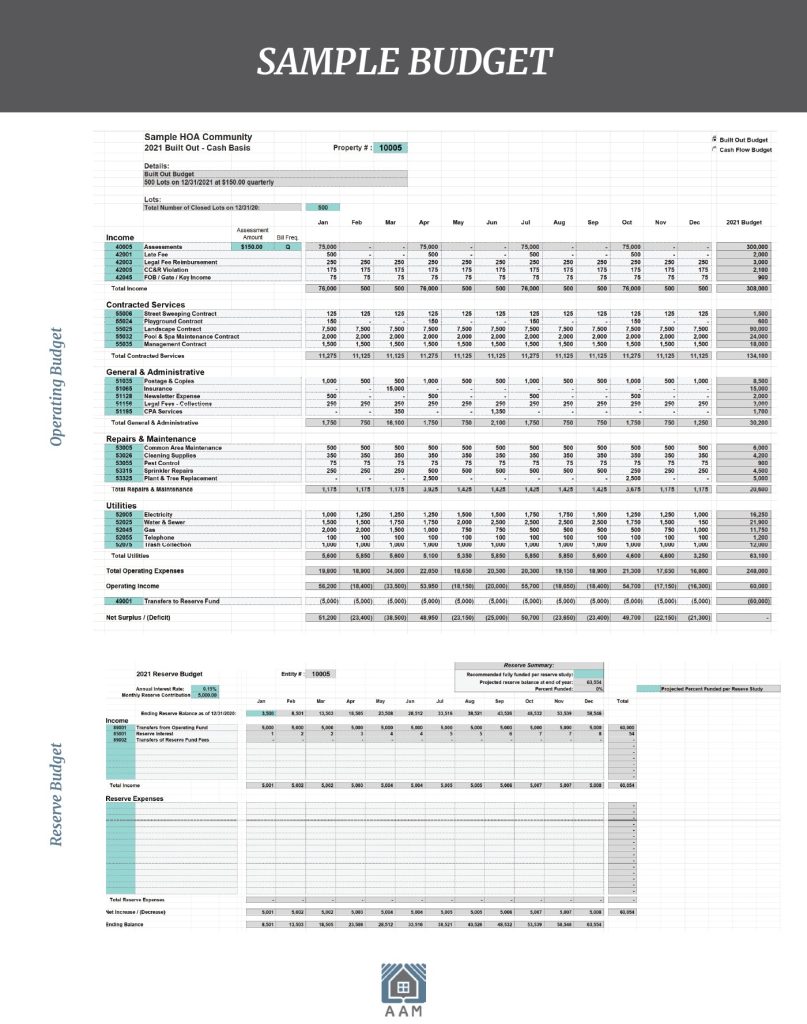
An HOA budget is more than a financial estimate; it is the foundation of a well-managed community. This guide explains how HOA budgets are structured, what they include, how they are developed, and when professional management can improve financial oversight. Specifically, the budget provides a detailed estimate of the association’s revenues, expenditures, and allocations toward reserve funds over a specified time frame, typically one year.
Generally, the association’s Community Manager collaborates with the HOA Board Treasurer to formulate a preliminary budget. Alternatively, some associations form a Budgetary Committee involving community member volunteers. This approach not only divides the responsibility but also boosts understanding and approval of the budget, enabling residents to have a say in allocating their contributions.
An HOA budget is more than a financial document; it is the cornerstone of a homeowner association’s operations, providing a comprehensive plan for managing community finances effectively. An HOA budget helps ensure the association thrives by addressing specific needs and challenges.
Here are the core components that define an HOA budget:
Informed Financial Decision-Making
Guides the board in making well-informed financial choices.
Anticipating Future Costs
Helps the board plan for the association’s upcoming expenses.
Managing Association Funds
Allocates funds responsibly for:
Maintenance
Utilities
Insurance
Administrative fees
Maintaining a Reserve Fund
Ensures a dedicated reserve fund is available for major repairs and replacements.
Setting Homeowner Dues
Determines the homeowner dues, the primary source of revenue for the HOA.
Accurate Financial Assessments
Equips the board to evaluate expenses and set fair assessments accurately.
By incorporating these elements, an HOA budget functions as a financial roadmap, supporting day-to-day operations while fostering long-term stability and transparency for the community.
Breaking Down an HOA Budget:
An HOA budget can be segmented into three primary divisions:
Income Streams:
Assessments
Expenditure Categories:
Administrative Expenses
Contracted Services
Repairs & Maintenance
Utilities
Reserve Fund Contributions:
Long-term projects
Significant Repairs
Future Replacements
Income primarily comes from homeowner assessments and dues, providing the funds needed to operate the community. Expenses cover day-to-day costs such as legal, management, landscaping, water, and waste, to name a few. The reserve funds are a dedicated allocation for significant repairs and future projects, ensuring the HOA remains financially stable and prepared for long-term needs. Together, these categories create a balanced financial plan that supports the community’s success.
When the HOA Board partners with a professional HOA management team, like AAM, an experienced accounting team guides the process or prepares a proper budget while offering invaluable insights for your annual budget planning.
How to Balance an HOA Budget?
The goal is to keep your budget balanced. If expenses exceed income, find ways to cut costs without lowering service quality. However, consider raising dues or a special assessment if balancing is still tricky. The main aim is to break even by the end of the year since associations are not-for-profit.
Additionally, adhering to due dates and stipulated deadlines for budgetary approval, as mentioned in the association’s legal documents, is paramount. Any delay or oversight could spark owner disputes or non-payment of dues.
Typical HOA budgets list expected income, expenses, and savings for reserves. If you’re new to this, online templates can help you with budgeting. We also have a Budgeting Tips Guide with a sample budget to help you plan.
In Conclusion
The HOA budget is an integral component of successful community management. It relies on rigorous data collection and computation, and the importance of early planning. Additionally, the budget indicates the residents’ dues amount while serving as a fiscal roadmap for the association’s finances.
Partner with AAM today to streamline your HOA budgeting process. Contact us for expert financial guidance tailored to your community.
Budget Planning, Review, and Financial Oversight Resources
If your board has been asking the same questions for months, you already know something is off.
Where are the financials? Why hasn’t the vendor called back? Why is this so hard to get a straight answer on?
It might sound like a big undertaking to change HOA management companies. And honestly, that feeling is part of why boards wait longer than they should. But staying with a company that isn’t delivering costs your community real money, real goodwill, and real time that nobody is getting back.
This guide covers the warning signs worth taking seriously, what the switch actually involves, and how to get through the transition without your community feeling the disruption.
Warning Signs Your HOA Needs a New Management Company
Most boards don’t make a change after one rough month. They make it after spending a year wondering why the same problems keep coming back. Here’s what to take seriously.
Financial reports are late, incomplete, or confusing
Your management company is handling real money that belongs to real people in your community. If the monthly financials show up late, don’t add up, or take three follow-up emails to make sense of, that’s a problem with controls, not just with communication.
Board members have fiduciary duties to homeowners. You genuinely cannot meet those obligations if the numbers you’re working with aren’t accurate and on time.
Maintenance requests go unanswered
Here’s the thing about slow maintenance response: homeowners don’t blame the management company. They blame the board. You’re the face they know.
When a work order gets submitted, and nothing happens for two weeks, that’s a conversation at the next meeting that you’ll be sitting through. Closed tickets that weren’t actually resolved, vendors who don’t return calls, follow-through that never comes, these are signs your management company is stretched too thin, or simply doesn’t have a system for tracking what’s open.
Board members are doing management company work
You raised your hand to serve your neighbors. You didn’t sign up to chase invoices, call vendors who should already be called, or compile monthly reports that your management company is supposed to be producing.
When you look at where your board’s time is actually going, and it’s mostly filling gaps that someone else should be filling, that’s worth paying attention to.
Homeowner complaints are escalating
When the same concerns start showing up at every board meeting, about response times, billing questions, and inconsistent rule enforcement, that pattern is telling you something.
A good management company resolves issues. A struggling one just passes them along. If your board keeps hearing the same complaints month after month, the company isn’t fixing the underlying problem.
Transparency is missing
You should be able to pull up your community’s financials, open work orders, violation notices, and vendor contracts without having to submit a request and wait.
If getting basic information requires a back-and-forth with your management company, that’s not just inconvenient. It’s a real exposure for your board, both legally and financially.
What to Expect When You Change HOA Management Companies
The process is genuinely more manageable than most boards expect. Here’s what it looks like from start to finish.:
Step 1 — Review your current contract
Start here before you do anything else. Pull your management agreement and find the termination clause. Most contracts require 30 to 90 days of written notice, and some have auto-renewal language that can lock you in if you miss a specific window.
Find your notice deadline. Then work backward from there to plan the rest of your timeline.
Step 2 — Hold a board vote
This is a board decision. In most cases, you don’t need to put it to a full homeowner vote, unless your CC&Rs specifically say otherwise.
Before you move forward, check your governing documents to confirm who has the authority to terminate your current contract and sign a new one. A majority board vote is typically all you need.
Step 3 — Interview and select a new management company
Talk to two or three companies before you decide. It’s worth the time.
When you’re in those conversations, push past the sales pitch and ask specifically:
How do you handle the transition and onboarding of our existing records?
What does your financial reporting look like, and what software do you use?
How do homeowners submit maintenance requests, and how are those tracked?
Do we get a dedicated manager, or does our community go into a shared queue?
Can you share references from communities similar to ours in size and type?
Step 4 — Issue a formal notice to your current company
Once your board votes, send a written notice to your current management company according to your contract terms. Keep a copy.
From this point on, your goal is a clean handoff. Whatever the relationship has been, you still need their cooperation during the transition. Records, financials, vendor contacts, all of it needs to transfer. A professional exit makes that easier
Step 5 — Transfer community records
Your new management company will take the lead on coordinating this. Expect the transfer to include:
Financial records and bank accounts
Vendor contracts and any open work orders
Homeowner contact information and assessment history
Governing documents, meeting minutes, and legal correspondence
Insurance policies and certificates
A professional management company does this regularly. Most transitions wrap up within 60 days of the notice being sent.
Step 6 — Communicate with homeowners
Once the transition is confirmed, send homeowners a simple, clear notice. Cover the effective date, the new contact information for maintenance and assessments, and a brief statement from the board.
Homeowners don’t need the full story behind the change. They need to know who to call and when it takes effect. Keep it short and matter-of-fact.
Thinking about making a move? AAM works with communities across Arizona, New Mexico, Texas, the Carolinas, Michigan, and Indiana. We handle the transition from start to finish, record and transfer, homeowner communications, and vendor introductions, so your board can focus on governing, not logistics.
Can an HOA Board Change Management Companies Without a Homeowner Vote?
In most cases, yes.
HOA management contracts are signed by the board of directors, and the authority to hire and fire management companies typically falls within the board’s powers under your CC&Rs and state law. You generally don’t need to call a meeting of all homeowners for this.
That said, check your own governing documents before assuming. Some associations do require membership approval for major contracts. Your CC&Rs or bylaws will say one way or the other. If you’re not sure, a quick review with your HOA attorney will get you a clear answer.
For context: Arizona law under A.R.S. Title 33 and the Texas Property Code both give HOA boards broad authority to manage association affairs, including vendor and management relationships, without requiring homeowner votes on operational decisions.
Ready to Make a Change
AAM has helped communities across the nation navigate this transition. We start with a straightforward proposal that shows you exactly how we’d manage your community: financials, maintenance, homeowner communications, and compliance.
No pressure, no commitment. Just a clear look at what a different management experience could look like for your community.
Managing finances is one of the most complex responsibilities for any self-managed HOA. While Board members are often dedicated volunteers, they may lack the financial expertise needed to navigate budgeting, reserves, and compliance with confidence. Recognizing when it’s time to seek professional financial management can be critical to maintaining your HOA’s financial stability and operational success. This article outlines eight key signs that your self-managed HOA might benefit from the support of a professional community management company.
8 Signs Your Self-Managed HOA Needs a Financial Pro
1. Lack of Financial Expertise:
Many HOA Boards are composed of community residents who may need more professional financial training and may find themselves at a disadvantage, struggling to navigate the complexities of taxes, a balance sheet, and budgeting. HOAs demand specialized knowledge in handling taxes, balance sheets, and budgets. A financial professional with HOA experience can guide the Board through these complex fiscal requirements, ensuring compliance and avoiding common financial errors.
2. Reliance on Manual Bookkeeping:
A self-managed HOA community may rely on manual bookkeeping methods, a traditional approach that often leads to significant errors and inefficiencies. Manually managing financial records is not only time-consuming but also prone to human error, which can have far-reaching implications for an HOA’s financial health and transparency. Automated financial management systems, managed by a professional community management company, can significantly enhance accuracy and efficiency, providing a more secure and streamlined approach to managing funds and preparing a precise HOA financial statement.
3. Struggling with Deadlines:
Managing your association’s financial records presents a complex challenge, especially when meeting critical financial deadlines. The intricacies of budgeting and financial planning are magnified under the pressure of looming deadlines, raising the risk of inaccuracies and hasty decisions. This is where the expertise of a professional HOA management team becomes invaluable. An experienced management team can offer the necessary support for accurate and timely HOA financial statements that align with the association’s bank account, easing the Board’s burden.
4. Recordkeeping Errors:
Self-managed accounting can lead to costly recordkeeping mistakes, such as tax return errors, an insufficient reserve fund, and inaccuracies in HOA financial statements. A community association Board should constantly review financial reports to ensure continuity, but this task can take time and effort. Professional HOA accountants maintain accurate records and help avoid potentially expensive oversights. By leveraging their expertise, community associations can ensure their financial health and compliance with relevant regulations while freeing up time for the Board to focus on other essential aspects of community management.
5. Overwhelmed by Budgeting:
Creating and managing a budget can be daunting, especially for a Board member who already shoulders significant community responsibilities. The intricate nature of planning an annual budget and the pressure to meet the community members’ expectations can be overwhelming. A professional HOA team brings a wealth of accounting experience to the table. They are well-versed in the nuances of HOA budgeting, from accurate forecasting to effective allocation of funds. This expertise ensures the community’s finances are managed efficiently, keeping an eye on current needs and future growth.
6. Overpaying for Services:
With expert oversight, HOAs can avoid overpaying for services. Regular financial audits conducted by a professional Manager are an effective way to identify areas where an HOA may be inadvertently overpaying for services. These audits thoroughly review the HOA’s expenditures, contracts, and service agreements. By analyzing these financial documents, a professional Manager can pinpoint areas where costs may be reduced without compromising the quality of services. This could include renegotiating contracts, finding more cost-effective service providers, or eliminating unnecessary expenses. Regular financial audits create transparency and trust within the community.
7. Inefficient Collection of Fees and Assessments:
Effective collection of dues and late fees is crucial for an HOA’s financial well-being. Collecting HOA dues and late fees is not just about maintaining financial stability; it’s also about ensuring legal compliance, fairness, and transparency, and ultimately contributing to the community’s overall value and quality of life. A professional HOA management team can ensure consistent and efficient collection processes, maintaining the community’s financial stability.
8. Inadequate Financial Planning for Long-Term Projects:
HOAs often undertake long-term projects, such as infrastructure improvements, which require meticulous planning and substantial reserve funds. These projects often incur significant maintenance costs, underlining the importance of an accurate HOA Reserve Study to forecast future expenses accurately. With expert guidance in planning for these substantial expenditures, HOAs can avoid encountering funding deficits or misappropriating resources. Partnering with an HOA management professional is crucial for strategic planning, ensuring these projects are financed and executed effectively without jeopardizing the association’s financial stability. Their expertise in managing Reserve Studies and maintenance costs is invaluable in safeguarding the association’s fiscal health while advancing critical infrastructure projects.
The Financial Benefits of Professional HOA Management
Professional HOA management not only ensures compliance and accuracy but also brings strategic insight into the association’s financial operations. It enhances the community’s trust in the HOA Board and its financial decisions to promote transparency, which is crucial for resident engagement and support.
Improved Financial Stability: Effective financial strategies lead to better budgeting, reduced costs, and increased savings for future projects.
Improved Community Appeal: Good financial strength directly impacts the overall appeal and value of the community’s properties.
Increased Member Satisfaction: Transparent and efficient financial handling improves trust and satisfaction among HOA members.
Choosing the Right Management Team for Your HOA’s Finances
As an HOA Board, selecting a qualified community management professional to oversee your HOA’s finances involves careful consideration. Consulting with other association members to seek recommendations on their suggested HOA management company or sending out Requests for Proposals (RFPs) to potential candidates can begin the process of finding a team that aligns with your association’s needs and budget.
Key Qualities to Look for in an HOA Management Team
Selecting the right team requires a deep understanding of several key qualities:
Expertise in Financial Management: A proficient team will have extensive knowledge in managing finances, specifically for HOAs. This includes understanding the nuances of HOA regulations and compliance requirements.
Transparency and Communication Skills: The team should exhibit a high level of transparency in their operations and be adept at communicating financial information clearly to all members of the HOA.
Advanced Technology Usage: Utilization of modern financial software and tools for efficient management and reporting is essential.
Proactive Approach to Financial Planning: Look for a team that doesn’t just manage finances but proactively plans for the future, including reserve studies and long-term budgeting.
Steps in Selecting the Right Community Management Team
Assess Your HOA’s Specific Needs: Understand the unique financial requirements of your community.
Research and Shortlist Potential Teams: Look for companies with a strong track record, positive reviews, and a robust referral list.
Conduct Interviews and Check References: Direct interaction and feedback from other HOAs can provide valuable insights.
Review and Compare Proposals: Carefully analyze the services offered and their costs. Management companies should be transparent with their costs; many times, Board members are disappointed to learn that the lower bid in monthly management fees resulted in higher monthly administrative costs. If the proposal doesn’t mention a cost, be sure to ask.
Make an Informed Decision: Choose a team that aligns with your HOA’s values and financial goals.
Choosing the right community management company is crucial, as expertise in financial management may vary across different organizations. Choose a firm that understands your state’s specific laws, regulations, and regional needs. AAM specializes in tailored financial solutions that align with your community’s unique needs and ensure transparency at the highest level.
If you’re seeking a partner who can easily and efficiently navigate the complexities of HOA finances, contact AAM today. Let us be the solution to managing your community’s financial needs.
Condominium association management requires a lot of time and energy, two things most condo association Board members don’t have in abundance. Busy condo boards rely on management companies to handle daily operations, ensuring smooth association management and peace of mind. Hiring the right management company will help simplify every aspect of association management and will bring peace of mind to both Board members and owners.
Why a Condominium Association should have a Management Company
Reduces Stress on Volunteer Board Members
Board members may still provide answers to owners’ questions and concerns. However, they no longer have to stress over the details. A qualified management company is available when needed and, most importantly, during monthly, quarterly, and annual Board meetings. They will provide the Board with detailed reports, including maintenance and financial reports, and a complete property analysis. When issues arise, board members can rely on their management company’s expertise to handle them in the most professional manner.
Vendor Management
There will inevitably be a major project going on in your condo association. Major systems like roofs, garages, facades, elevators, HVAC, and fire alarms naturally degrade and require timely repairs or replacement. When this happens, you can expect the management company to be there from beginning to end. From creating and sending requests for proposals or RFPs, to coordinating with vendors and communicating with owners, your management team will ensure the project is completed as presented to the Board.
Maintaining the Value and Aesthetics of the Association and the Amenities
Living in a condo association that is professionally managed means you can rest assured knowing it will look and feel its best. Details will no longer slip through the cracks. When facilities are not just maintained but improved upon, the value of the community rises. It becomes more desirable to live there, and that positive reputation spreads. Hiring the right management company is not an expense but an investment.
Offers Resources and Knowledge from Experience
Part of what makes condo living so attractive is the fact that you’re moving into a well-managed and connected community. But this doesn’t happen by accident. An organized, experienced management company ensures the success of your condo buildings and complexes. Many condo associations feature impressive services and amenities. Examples could include meeting rooms, swimming pools, social spaces, gyms, rooftop decks, and even access to ground-level retail establishments. Your Board of Directors needs an up-to-date management team with access to all the latest software, technology, best practices, and legal requirements associated with managing a condo association.
How Much Do Management Companies Charge to Manage a Condominium Association?
The ongoing management fee is a contracted fee that a condo association pays, usually on a monthly basis. This fee is typically negotiated in advance between the company and the association. Management companies charge a monthly fee in exchange for their management services. The amount can vary depending on several variables, such as services provided, staffing requirements, amenities offered, and community size.
What are the standard management services included
Understanding of state-specific condominium statutes
Maintenance schedules and reserve analyses
Financial management
Conducting inspections
Communication with owners
HR Recruiting
IT Services
Community Websites
The selected management company for your HOA must understandthat every community is unique and offers a tailored management approach to meet individual needs. Their mission should be to provide friendly, professional condo association management services to help minimize the pressures and daily operations for the Board and owners.
Our professional condominium management team delivers top-quality services tailored to your condo community’s unique needs.